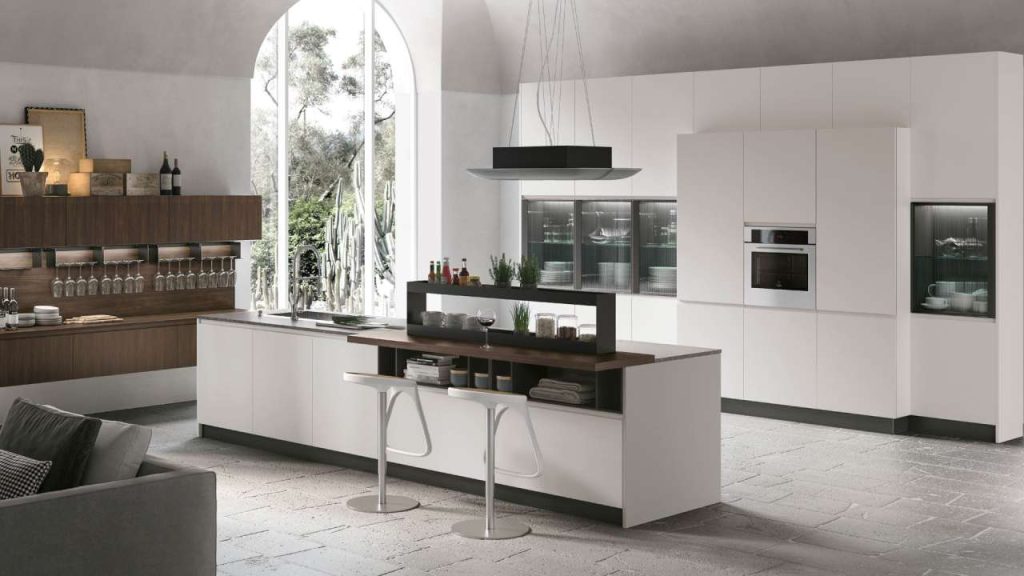
White-painted cabinets occupy an unusual position in kitchen design: they are simultaneously the safest specification and the easiest one to get wrong. A designer can specify white on a project with complete confidence about the aesthetic outcome, and still end up with a kitchen that shows every fingerprint, yellows unevenly, or chips along the drawer edges within three years. The difference between those outcomes has almost nothing to do with the color. It is decided by the substrate, the coating system, the spray environment, and the hardware screwed into the doors afterward.
This guide treats white-painted cabinets as an engineering problem as much as a styling one: what the finish actually is, why the same white looks different on two adjacent samples, which sheen levels survive real households, and how to specify a job so the paint is still intact when the appliances are replaced.
Why White-Painted Cabinets Still Set the Standard
White remains the most specified cabinet color in most residential markets, for structural rather than fashionable reasons. It reflects light, which matters in the compact kitchens and narrow galley layouts that dominate urban housing. It reads as clean, which buyers equate with low maintenance. It does not compete with countertop veining or floor pattern, so a single dramatic material elsewhere in the room can carry the design. And white is the one color that can be repainted on site years later without a visible color-matching exercise.
The trade-off is honesty. White shows everything: grease film above the range, water spotting below the sink, hairline cracks at joints, uneven sheen from a rushed spray pass. A walnut veneer absorbs small defects; a white-painted door will not. That is precisely why white-painted cabinets are a useful test of manufacturing quality — if a factory can produce a clean white door, it can produce anything.
Separate Paint From Everything Pretending to Be Paint
Much of the confusion in this market comes from calling several different products “painted.” They behave differently, age differently, and should be priced differently.
True painted finishes
A genuine painted door is coated after assembly, with the coating applied to a primed substrate and cured in a controlled environment. The coating may be a water-based acrylic enamel, a solvent-borne conversion varnish, or a two-component polyurethane. These systems are sprayed, they form a film, and they can be sanded and re-coated. They are repairable, and they are what most people mean when they ask for white-painted cabinets.
Lacquer and 2K polyurethane
These sit at the high end of the painted category. A 2K polyurethane topcoat cross-links chemically, producing a harder, more chemically resistant film than a single-component paint, and it resists the yellowing that affects oil-modified products. The cost is real: these systems require a spray booth with extraction and temperature control, and they cannot be brushed on site without visible loss of quality.
Thermofoil, vinyl wrap, and melamine
These are decorative films bonded to a substrate. They may look like white paint on a sample board, but they are not paint. They cannot be touched up, they delaminate at edges exposed to heat, and they fail catastrophically rather than gracefully. A thermofoil door near an oven will eventually peel, and there is no repair short of replacement. If a quotation describes a “white painted finish” at a price that seems too low, this is usually where the difference sits.
What Sits Beneath the Paint Matters More Than the Paint
MDF and HDF are the default for painted doors, and for good reason. The material is dimensionally stable, has no grain to telegraph through the film, and machines into a crisp profile. A shaker door made from MDF takes paint with a flatter, more uniform result than a solid-wood door, because there is no grain movement between seasons. The requirement is density: a low-density board will show edge swelling if moisture reaches a machined edge. High-density board, sealed on all faces including the top and bottom of the door, is the specification to ask for.
Plywood is preferred for cabinet boxes, and for door styles where visible grain is intended. On a painted door it brings a risk: the grain pattern can print through the finish over time as the wood moves, particularly on flat slab doors in a warm kitchen. Plywood is an excellent core, but painted flat doors are usually better served by MDF faces.
Solid wood belongs on frames, rails, and stiles where structural strength or a profiled edge is required. It moves with humidity, which is why a painted solid-wood door often develops a fine crack along a joint after the first heating season. The joint did not fail; the two pieces moved at different rates. Frame-and-panel construction with a floating panel accommodates that movement. Glued-up solid slabs do not.
Choosing a Sheen: Matte, Satin, Semi-Gloss, Gloss
Matte (roughly 5 to 10 units at 60 degrees) reads as calm and architectural, and hides surface imperfections better than any other level. It is also the least forgiving of cleaning: repeated wiping with an abrasive cloth polishes the area into a subtle sheen patch that becomes visible under raking light. Matte suits low-traffic areas, tall pantry runs, and designs where a plaster-like wall plane is the goal.
Satin (around 25 to 35 units) is the sensible middle. It reflects enough light to feel clean, hides fingerprints reasonably, and tolerates normal cleaning without changing appearance. For a family kitchen, satin is the default recommendation.
Semi-gloss (45 to 60 units) is traditional, durable, and easy to wipe, which is why it remains common in rental and commercial work. It also amplifies any waviness in the door face. On a large flat slab door, semi-gloss shows every deviation in the substrate, including the ones the paint was supposed to hide.
Gloss is a specialist choice. A true high-gloss finish requires a perfectly flat substrate, a dust-controlled spray environment, and polishing. Most production cabinet lines do not genuinely offer it, whatever the sample board suggests.
Color Temperature: The Decision Most Buyers Get Wrong
“White” is not a specification. There are hundreds of whites, and the ones that look identical on a sample chip will look different once they cover forty square meters of vertical surface.
Whites fall along a temperature axis. Warm whites carry a trace of yellow or red and pair naturally with wood floors, brass hardware, and 2700K lighting. Cool whites carry a trace of blue or gray and read crisp against stone, stainless, and 4000K lighting. Either can be correct; the failure mode is mixing them — a cool cabinet white against a warm oak floor will make one of the two look dirty, and it will be the cabinet.
Three rules reduce the risk substantially. Evaluate the sample under the lighting that will actually be installed, at night, not in a showroom with daylight tubes. View it against the actual floor and countertop materials, because contrast is judged relatively. And order a full door in the specified finish rather than relying on a 100 mm chip: a chip shows color, a door shows color, sheen, edge detail, and shadow line together.
Door Styles That Reward a Painted Finish
Paint flatters geometry that would look busy in a grained veneer. Shaker doors — a flat center panel inside a simple four-piece frame — are the reference case for most modern kitchen cabinets: the paint unifies frame and panel into a single reading, and the shadow line provides all the articulation the design needs. Beadboard and vertical grooving also work well, because the profile creates shadow rather than texture.
Approach glazed or antiqued finishes with caution: they depend on hand application that is difficult to reproduce consistently across a large order. And avoid any design that relies on visible wood grain as part of its character, since the paint will remove it. Flat slab doors are the most demanding — with no frame to break up the surface, any waviness in the substrate or unevenness in the spray pattern becomes the dominant visual feature. A flat painted door is a quality statement, not an economy one.
Hardware and Contrast
White-painted cabinets change how hardware reads. Against a dark stained cabinet, a brushed nickel pull recedes. Against white, the same pull becomes a graphic element, repeated perhaps thirty times across the room. That repetition is either the design’s rhythm or its noise, and the choice is made by the hardware selection.
Three approaches work reliably. Matching the metal to the plumbing fixtures and lighting produces a calm, coherent result. A deliberate single contrast — matte black on white, or unlacquered brass on white — reads stronger and more period-appropriate. Integrated or finger-pull detailing removes the question entirely and suits modern slab designs, though it puts more visual weight on the door edges and therefore on the quality of the paint film there.
Durability, Cleaning, and Touch-Ups
A properly cured 2K polyurethane or conversion varnish film on a sealed MDF door will handle a normal domestic kitchen for a decade or more without structural failure. What it will not do is resist every cleaning product sold for kitchens. Abrasive creams, bleach-based sprays, and melamine sponges all remove gloss and, eventually, film. The safe routine is a damp microfiber cloth with mild dish soap, dried immediately, plus a non-abrasive cleaner for grease above the range.
Touch-ups are the practical test of a paint system. A water-based or 2K system can be touched up with the original material, thinned and applied sparingly with a fine brush, then blended by hand. The repair will be visible at close range; it will not be visible from across the room. A thermofoil or vinyl surface offers no equivalent — the only repair is a new door.
Two areas deserve specific attention. Around the dishwasher and oven, heat and steam degrade film edges faster than anywhere else in the kitchen, so a sealed edge and a small clearance gap extend service life considerably. Below the sink, any leak that reaches a machined MDF edge causes swelling that no amount of repainting can reverse; sealant and edge banding are cheap insurance.
Where White-Painted Cabinets Fail
Failures cluster into a few predictable patterns. Yellowing occurs when an oil-modified product is used in a space without adequate UV exposure, or when the clear topcoat above the white is not UV-stabilized. Chipping along door and drawer edges indicates insufficient film build on the machined edge, the hardest area to coat and the easiest to under-spray. Visible sanding scratches appear when the primer is sanded through and not re-primed. And “orange peel” texture signals spray viscosity or gun distance problems that no amount of polishing will correct.
None of these are color problems. All are process problems, which is why the useful question for a supplier is not “what white is this?” but “how is the edge sealed, what is the film build, and what is the cure schedule?”
Cost Structure
Price differences between quotations for apparently identical white-painted cabinets usually trace to four variables: substrate density and sealing, coating system (single-component versus 2K polyurethane or conversion varnish), number of coats and whether edges are hand-sealed, and the spray environment. The cheapest credible specification is a sealed high-density MDF door, primed, with two topcoats of a water-based enamel in satin. The most durable common specification is the same substrate with a 2K polyurethane system at the same sheen. The visual difference at handover is minimal; the difference in year eight is not.
Beyond the Kitchen
The same finish logic transfers to bathrooms, laundries, and built-in joinery, with one adjustment: moisture exposure rises and ventilation often falls. In a bathroom, painted bathroom vanities and cabinets should be sealed on all six faces of every door and panel, including the ones nobody sees, and matte sheens should be avoided in shower-adjacent zones because they hold water film longer. Built-in wardrobes and hallway joinery are the easiest application of all: low moisture, low heat, low traffic, and the place where a matte white-painted finish performs best.
A Specification Checklist
Before signing a cabinet order for white-painted doors, confirm the following in writing:
- Substrate type and density, with the formaldehyde emission class documented.
- Which faces are sealed, and whether machined edges receive a separate sealing step.
- Coating system by name and chemistry — not simply “painted.”
- Number of primer and topcoat passes, and the film build target.
- Sheen level expressed numerically, not as “matte” or “semi-gloss.”
- Color reference by manufacturer code, plus a full-size door sample approved before production.
- Cure time before packing and shipping.
- Touch-up material supplied with the order, from the same batch.
- Warranty terms that distinguish film defects from mechanical damage.
Frequently Asked Questions
Do white-painted cabinets turn yellow? Older oil-modified coatings did, particularly in low-light rooms. Modern water-based acrylics and 2K polyurethanes are formulated to resist yellowing, but any clear topcoat above the white must also be UV-stabilized. The risk is a property of the coating chemistry, not of the color.
Can white-painted cabinets be repainted later? Yes, if the original finish is a genuine paint film. The doors are removed, degreased, lightly sanded, and re-coated. This is not possible on thermofoil or vinyl-wrapped doors, which must be replaced.
Is matte or satin better for a busy family kitchen? Satin. It tolerates repeated cleaning without developing polished patches, and it hides fingerprints better than matte while showing fewer substrate imperfections than semi-gloss.
Why do the same white cabinets look different in two rooms? Because color is judged relative to surrounding surfaces and lighting. A white with a warm undertone reads cream next to a cool gray wall and crisp next to an oak floor. Approving a full door under the actual lighting is the only reliable control.
Conclusion
White-painted cabinets are a specification, not a color choice. The decisions that determine whether they still look right in ten years are made before any paint is mixed: which board goes under the film, how the machined edges are sealed, which chemistry is sprayed, at what sheen, and how long it cures. Get those right and white is the most durable, flexible, and quietly confident finish available. Get them wrong and the same white becomes a permanent record of every shortcut taken in the factory.